
Choose How You Want to Understand My Work
AI cannot be understood – or governed – through a single lens. My work spans industry, policy, and academia, combining these perspectives to identify where risk emerges, how it propagates, and which interventions are most likely to hold in real-world systems. Cassowary Research Services integrates all three lenses into consistent policy and firm research frameworks that focus on tangible impacts and practical results.
Pick the lens you want to use first.
Industry
I did not stand next to AI systems. I worked inside them. I sat with engineers and data scientists while models failed in ways no demo shows. I saw what happens when something that works in a notebook meets regulation, scale, and a client who cannot afford to be wrong.
At Medallia, those systems ran inside Fortune 100 institutions – finance, government, critical services. The problems were never abstract. They were about whether the system held under pressure. Compute ceilings. Data constraints. Regulatory friction under frameworks like the EU AI Act and GDPR. Teams pulling in different directions. Incentives that did not align. This is where systems break. Not in theory. In deployment.
I was responsible for making those systems legible – to executives, to governments, to rooms of thousands. I delivered keynotes to audiences of over 4,000. I built the strategy behind how these systems were understood and trusted. I was the first product marketer in the company’s history to make President’s Club. Not just because I sold well. Because I understood what I was selling.
I started earlier than that. NLP systems. Speech-to-text. Testing accuracy in French. Breaking models on purpose to see where they failed. My background is computational mathematics. I do not guess how systems behave. I test them. I watch them break. Then I ask what that means at scale.
Most people talk about AI risk from a distance. I learned it at the point of failure – where models become systems, and systems meet the real world. That is where governance matters for real-world customers with real-world stakes.
Choose another lens →Policy & Dialogue
I do not wait for policy to catch up to AI. I bring the problem into rooms where people have to act on it. As the US delegate to the Y7 – the official youth track feeding into the G7 – I wrote AI recommendations that moved upstream to heads of government. Not commentary. Direction.
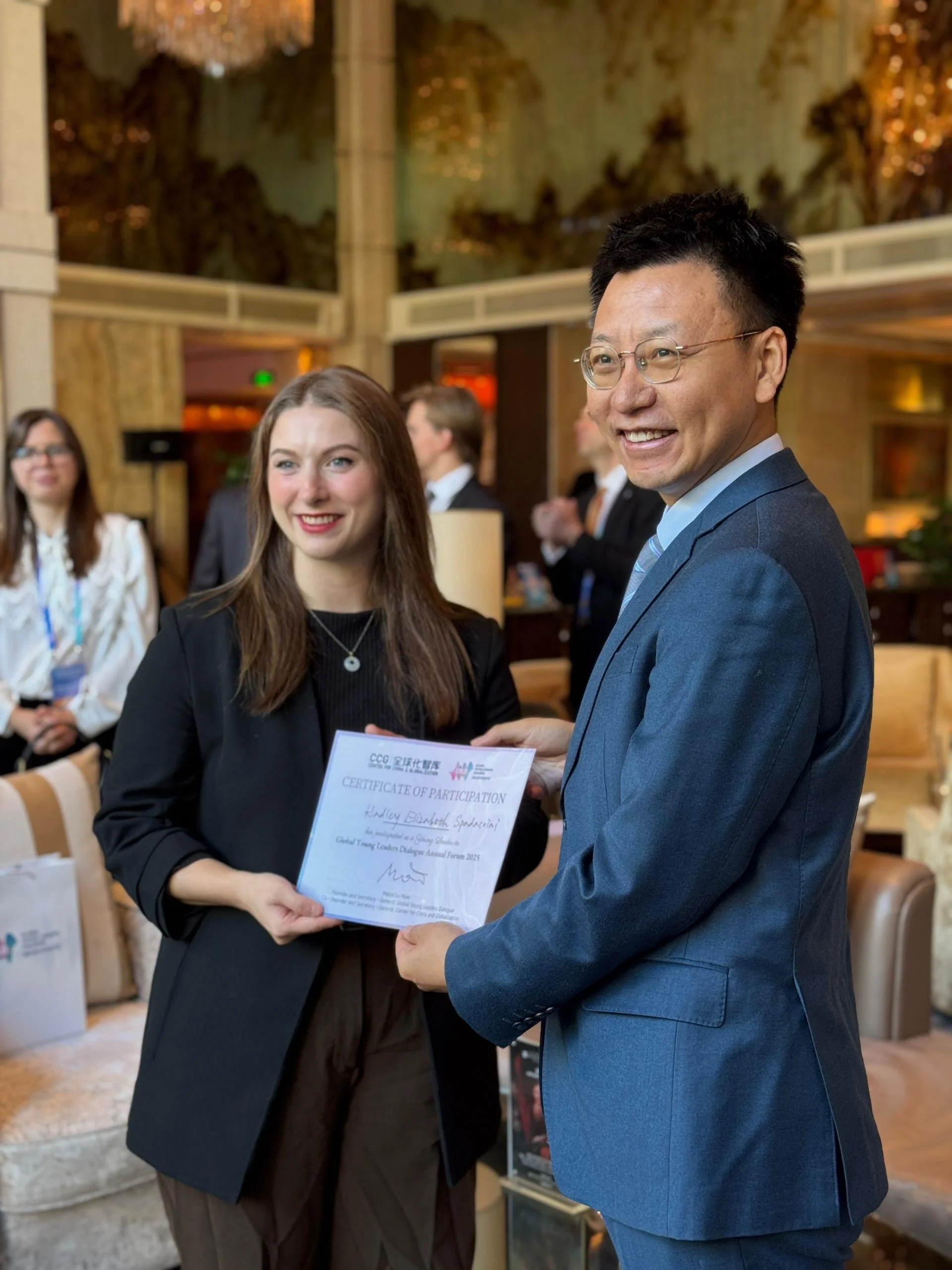
I continue that work in Track II settings – the Montecito Ideas Forum and the Global Young Leaders Dialogue at the Center for China and Globalization – where policymakers, financial leaders, and industry operators test what is actually viable. These conversations are constrained by capital, politics, and time. That is where most policy fails.
My approach is grounded in policy work beyond the room. At the Quincy Institute and the Hertog Foundation, I worked on research at the intersection of AI, economic statecraft, and security. At Exovera and Norcross Group, I conducted Mandarin-language due diligence under US regulatory frameworks, tracing how policy actually shapes firm behavior. At NCCU, I study semiconductor supply chains and technological interdependence – where the limits of AI are not theoretical, but material.
I focus on what survives those constraints. Not broad principles. Mechanisms. Training data traceability that firms can implement. Transparency that does not collapse under scale. Evaluation standards that force acknowledgment of what models cannot do. Dataset controls that shape behavior before deployment – reducing bias, limiting harmful outputs, reinforcing constraints where needed. Systems that make misuse harder – not just illegal.
Compute still matters. Models scale on infrastructure – chips, energy, and supply chains. Export controls, access to advanced semiconductors, and constraints on critical minerals shape what can be built, and how fast risk can scale. But compute alone does not determine outcomes. Risk emerges in how systems are trained, evaluated, and deployed on top of it.
I have seen how firms respond when policy is unclear or performative. They hesitate, or they move anyway under misunderstood risk. Neither outcome is safe. The goal is not to slow development. It is to reduce the probability of failure at scale – misuse, loss of control, and systems deployed beyond what they can safely handle. Policy that cannot survive contact with deployment is theater. I work on what remains after that.
Choose another lens →Academia
My academic work asks a different question – not what AI can do, but what makes it possible. I trained first in computational mathematics, then in econometrics and statistics, and later in international relations focused on China and Taiwan. These are not separate fields. They describe the same system from different entry points.
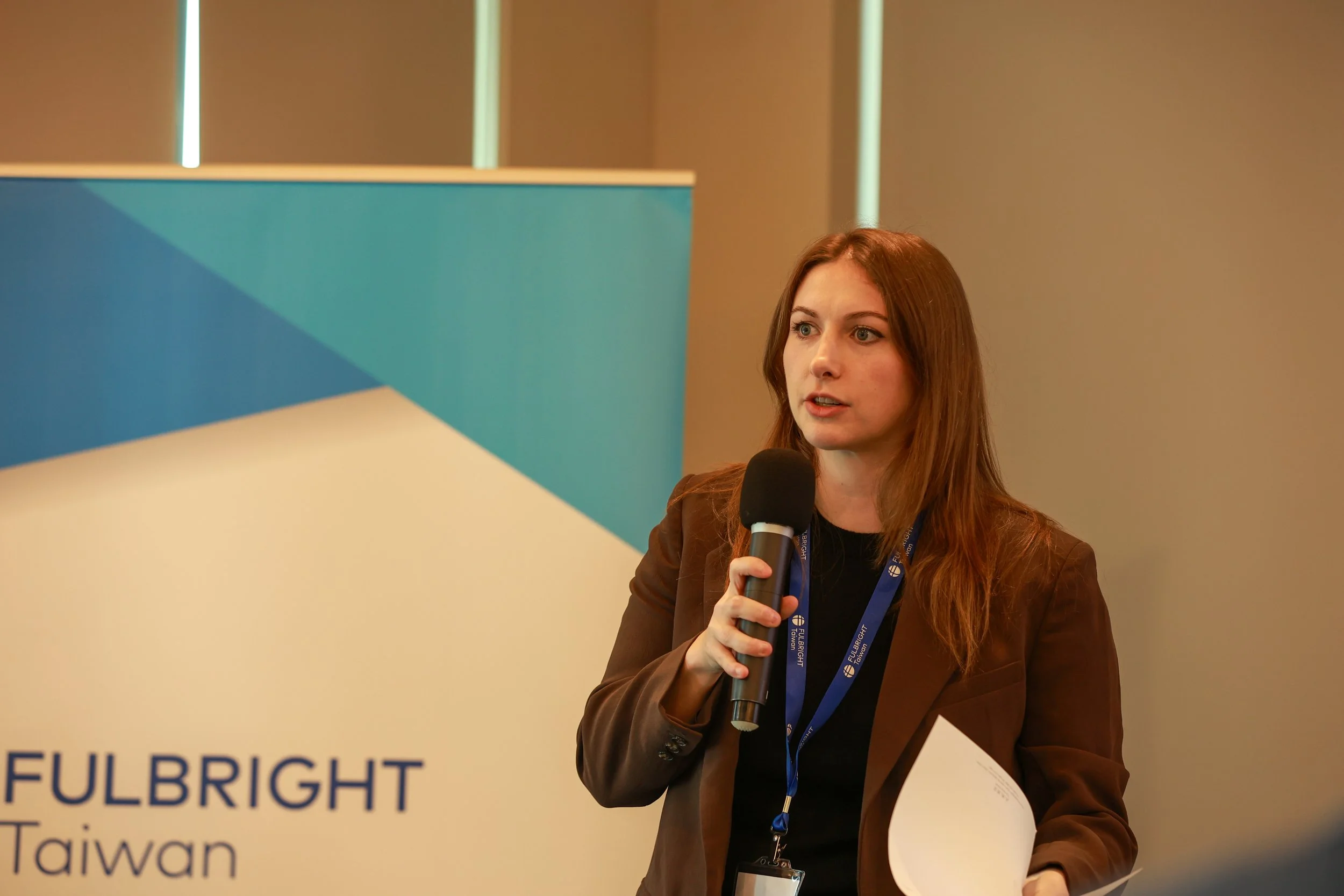
That path has been selected, repeatedly, into demanding environments. I am a Fulbright Scholar at National Tsing Hua University, a program defined by national-level competition and trust. Earlier, I was awarded the FLAS Fellowship, the Boren Scholarship, and the Freeman-Asia Scholarship – all built to place students in difficult language, policy, and regional contexts where the work cannot be superficial. Selection here is not about prestige. It is about whether you can do the work.
At NTHU, I study the political economy of technology in the place where it matters most. AI runs on chips. Chips run through Taiwan. Advanced models depend on compute, and compute depends on a narrow set of firms, facilities, and policies concentrated here. This is not peripheral to the AI story. It is the constraint that shapes it.
My research follows capability under pressure – how export controls, capital limits, and industrial policy reshape what firms build and where they build it. That work requires access and fluency. I conduct research in Mandarin, draw from Chinese- and English-language sources, and track cross-strait dynamics as they move through supply chains. These are not background details. They determine how technology moves, where it concentrates, and how risk spreads.
I have also been selected into highly competitive academic forums, including the Yenching Global Symposium, where acceptance rates fall below 1.5 percent. These environments bring together researchers and practitioners working on the same problem from different angles. They reinforce a simple point – no single discipline is enough.
This is where my approach to AI risk takes shape. Not as a purely technical problem, and not as a purely political one, but as a system defined by incentives, constraints, and interdependence. The question is not only how to govern AI once it exists. It is how the conditions that produce it shape the risks we face. That is where the most consequential work remains.
Choose another lens →